
For Christians, this connection sheds light on why Scripture speaks so strongly about the value of human life. If you are not a Christian or a Jew, what follows may not carry much significance for you. But you are welcome to read it anyway.
Before continuing, I want to acknowledge that abortion is not merely a political issue. For many people it is deeply personal. Some who read this may have experienced an abortion in their past and carry profound grief, regret, or unanswered questions because of it.
Nothing in this article is intended to deny the mercy, forgiveness, and restoration that are available in Jesus Christ. My purpose is not to condemn people but to explore a biblical theme that I believe strengthens the case for the value and dignity of human life.
There appears to be a surprising connection between the biblical imagery of hell and an ancient practice involving the sacrifice of children. In fact, I believe that connection helps explain why Jesus and Israel’s prophets spoke about divine judgment the way they did.
Here's where we're going, strength and emphasis mine:
“You have heard that it was said to the people long ago, ‘You shall not murder, and anyone who murders will be subject to judgment.’ But I tell you that anyone who is angry with a brother or sister will be subject to judgment. Again, anyone who says to a brother or sister, ‘Raca,’ is answerable to the court. And anyone who says, ‘You fool!’ will be in danger of the fire of hell.”Jesus, speaking here in a section where He “turns up” the common teachings Israel already had, said that murder, of course, is wrong ... in fact, even saying “you fool” is also wrong and puts one “in danger of the fire of hell.”
– Jesus, in Matthew 5:21-22
But what does He mean by hell? Most Christians think of hell only as a place of judgment for those who reject Jesus and therefore are punished for their sin. While I believe that understanding is broadly correct, I think Jesus is also drawing on a much older biblical image that is easy for modern readers to miss.
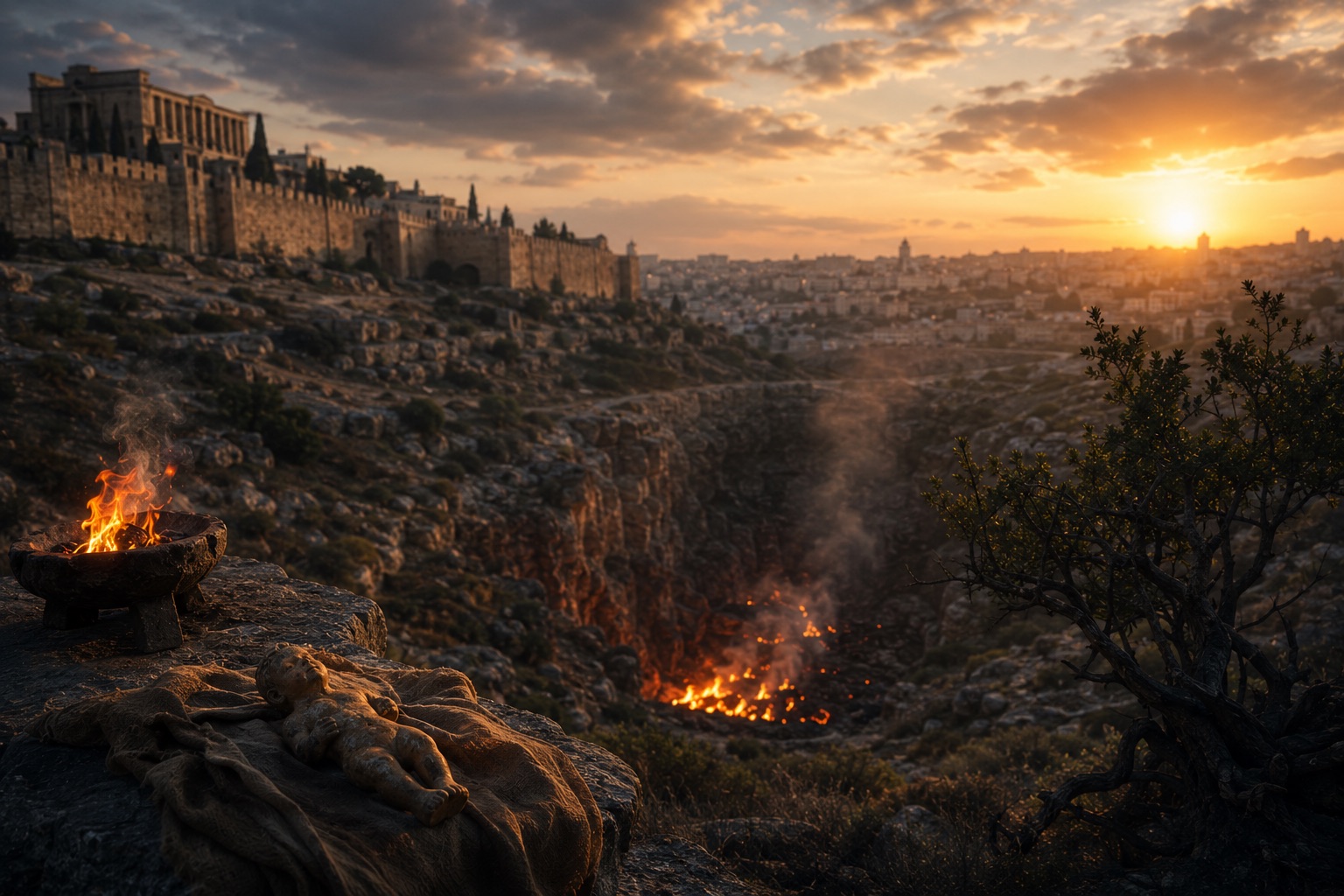
In Greek, the original language of the New Testament, the word “hell” is translated from the word Gehenna (Γέεννα). Gehenna is really not a Greek word, though, for hell or for anything else. It's actually a Hebrew/Aramaic name of a place that was transliterated into the Greek language. It's referring to a valley just south of Jerusalem's central hills Zion and Moriah: The Valley of Hinnom, or in Hebrew גֵּיא הִנֹּם “Gei-hinnom.”1 And that place has incredibly significant meaning in the Hebrew Bible for both Christians and Jews.
Israel, being a desert region then, as it is now, lacked frequent rain. Little rain means little crops. Little crops means hunger, discomfort, and disease. Inconvenience. Personal suffering. This was a particularly strong reason the Israelites frequently fell into the worship of Ba'al. (“Ugaritic records show Ba'al as a weather god, with particular power over lightning, wind, rain, and fertility.”2)
Of course, the predominant form of worship in the ancient world was animal sacrifice. But history and the biblical record show Israel turned remarkably and disturbingly desperate at certain times. (Ba'al, apparently, wasn't helping quickly enough.) They thought he required more than animals. So they started sacrificing their own children. Let's watch this unfold in Jeremiah 19:1-8, strength and emphasis mine:
1 Thus says the LORD, “Go, buy a potter's earthenware flask, and take some of the elders of the people and some of the elders of the priests,So there is fire in Gei-hinnom (the Valley of Hinnom, translated “hell” in many English New Testaments). But who lit it? According to Jeremiah, it was not God. The people themselves kindled those fires, and God describes what they were doing as something He neither commanded nor desired.
2 and go out to the Valley of the Son of Hinnom at the entry of the Potsherd Gate, and proclaim there the words that I tell you.
3 You shall say, ‘Hear the word of the LORD, O kings of Judah and inhabitants of Jerusalem. Thus says the LORD of hosts, the God of Israel: Behold, I am bringing such disaster upon this place that the ears of everyone who hears of it will tingle.
4 Because the people have forsaken me and have profaned this place by making offerings in it to other gods whom neither they nor their fathers nor the kings of Judah have known; and because they have filled this place with the blood of innocents,
5 and have built the high places of Baal to burn their sons [children] in the fire as burnt offerings to Baal, which I did not command or decree, nor did it come into my mind—
6 therefore, behold, days are coming, declares the LORD, when this place shall no more be called Topheth, or the Valley of the Son of Hinnom, but the Valley of Slaughter.
7 And in this place I will make void the plans of Judah and Jerusalem, and will cause their people to fall by the sword before their enemies, and by the hand of those who seek their life. I will give their dead bodies for food to the birds of the air and to the beasts of the earth.
8 And I will make this city a horror, a thing to be hissed at. Everyone who passes by it will be horrified and will hiss because of all its wounds.
WE (humans) lit the fires of Gei-hinnom to pass our children through the fire as a sacrifice, hoping for rain and prosperity. In other words, children were destroyed in pursuit of outcomes that adults believed would improve their circumstances.
That is what makes this passage so disturbing. Human beings were willing to sacrifice the most vulnerable among them in the hope of obtaining what they believed would bring relief, prosperity, or a better future.
God's response: This would become the place He brings the guilty back to see their destruction. This will be a sign to all who see it. And the name of that very place, Gei-hinnom, where humans sacrificed their children for rain (which to a desert community means prosperity), became the imagery and vocabulary Israel's prophets and later Jesus used to talk about how God would deal with human evil -- even in this life. At least in Jeremiah’s immediate context, the emphasis is not on people being burned in fire, but on human wickedness bringing destruction back upon itself.
To be clear, I am not suggesting that every abortion occurs for the same reasons that ancient Israelites sacrificed children to Molech. The historical circumstances are obviously different.
My point is narrower: Scripture consistently treats the destruction of children as a profound violation of God's design for human life. Because of that, it is noteworthy that the very geography associated with child sacrifice later became associated with divine judgment.
Whether one agrees with every aspect of the comparison or not, the connection is difficult to ignore: the biblical location most associated with the destruction of children later became the primary image Scripture uses for divine judgment.
For Christians, the story does not end in the Valley of Hinnom.
The same God who condemns the shedding of innocent blood also extends mercy to sinners through Jesus Christ. Every one of us stands in need of that mercy. Whatever mistakes may lie in our past, the Gospel offers forgiveness, restoration, and hope.
My purpose in exploring this connection is not to condemn anyone, but to highlight how seriously Scripture treats the value of human life and how deeply God cares for the innocent and vulnerable.
I hope you found this both helpful and interesting.
References:
1 - https://www.wikiwand.com/en/Valley_of_Hinnom_(Gehenna)
2 - Wikipedia, referencing Herrmann, Wolfgang (1999a), “Baal”, in Toorn, Karel van der; Becking, Bob; Horst, Pieter Willem van der (eds.), Dictionary of Deities and Demons in the Bible, 2nd ed., Grand Rapids: Wm. B. Eerdmans Publishing, pp. 132–139.